

Ant Extermination
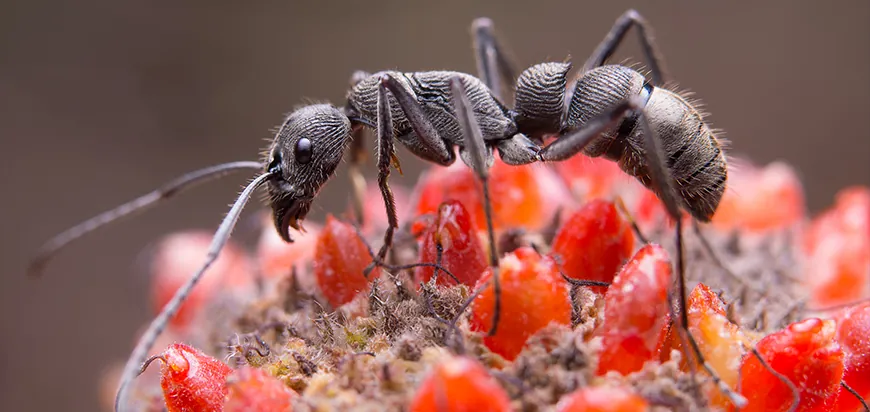
| Length: | 1 to 3 mm long |
|---|---|
| Color: | Brown to Black |
| Treatment | Spraying, Dusting, Applying Gel and Bait Station. |
Ants are eliminated by getting workers to carry bait back to the nest, not by spraying the ones you can see. Spraying kills foragers and leaves the queen producing replacements. With several species it also triggers budding, where a disturbed colony splits into multiple new nests and the problem gets larger.
Carpenter ants are the exception that matters in Ontario. They do not eat wood like termites, they excavate galleries in it, so they are a structural concern rather than a food one. Coarse sawdust-like shavings near skirting, window frames or a deck usually means an active nest in damp or previously water-damaged timber.
We can get rid of ants by applying government approved chemicals.
For more details about ants please visit Health Canada on carpenter ants and Health Canada on ants.
Ant Extermination Services
Identification comes first, because the treatment differs by species. Pavement ants — the small dark ants that nest under slabs, driveways and patio stones — respond well to bait. Carpenter ants need the nest located rather than the trail treated. Pharaoh ants should never be sprayed at all, because it makes the colony bud into several new ones.
The trail on the counter is a small fraction of the colony. Foraging workers are a minority of the population, so killing the ones you can see changes nothing while the queen keeps producing replacements. Bait works precisely because those workers carry it back and share it, reaching the brood and the queen.
Call 226-606-7378, or use the form on this page to arrange an assessment.
How Ant Treatment Works
Treatment starts by following the trail rather than clearing it. A trail leads back toward the nest, so we track where it enters and exits, whether it continues outdoors, and what the ants are feeding on — grease, protein or sugar, which changes through the season and determines which bait they will accept.
Where the nest is outdoors, the perimeter and the entry route are treated. Where it is indoors, bait is placed along the established trail and left undisturbed. Wiping the trail away or spraying it makes the situation harder to read, and with some species scatters the colony instead of reducing it.
Carpenter Ants
Carpenter ants do not eat wood. They excavate galleries in it to nest, which makes them a structural concern rather than a food one, and it is what separates their damage from a termite’s. They favour wood that is damp or has been water-damaged, so nests turn up around leaking window frames, bathroom walls, deck posts and roof edges — which means a carpenter ant problem is often a moisture problem first.
The usual signs are coarse shavings that look like pencil sharpenings, a faint rustling inside a wall on a quiet evening, and large winged ants indoors in spring. Winged ants inside generally indicate a nest in the building rather than one that wandered in.
A parent nest outdoors with satellite nests indoors is common, so treating only what is visible inside can leave the main colony untouched.
Preparation For Ants's Treatment By The Homeowner
1- Empty kitchen cupboards, washroom cupboards beneath the sink and the place where they are seen.
2- Kitchen counter top should be clean and clear. No dirty dishes.
3- Remove food, dishes, pots and cutlery from the kitchen and clear the cupboards and drawers.
4- Base boards in the kitchen and bath rooms should be accessible for spray.
5- Pull away stove and fridge from the wall and clean out behind stove and fridge.
6- Any person or pet will not stay inside the house during treatment. If you have fish aquarium, turn off the air pump and cover the top, after treatment leave the house vacant at least for 4 hours.
7- Alder Pest Control Inc. is not responsible for any pest damage to the structure and property before, during or after pest inspection or treatment or any contents within.
8- People and pets can only enter the treated indoors areas after the restricted-entry interval of 4 hours or advised by the pest control technician. Ventilate treated areas either by opening windows and doors or through use of air exchange/ventilation systems confirmed to be operational. Use fans where required to aid in the circulation of air. If you experience respiratory effects after additional ventilation, contact your health care professional.
9- Please do not leave your valuables unattended, Alder Pest Control Inc. is not responsible for any loss or damage.